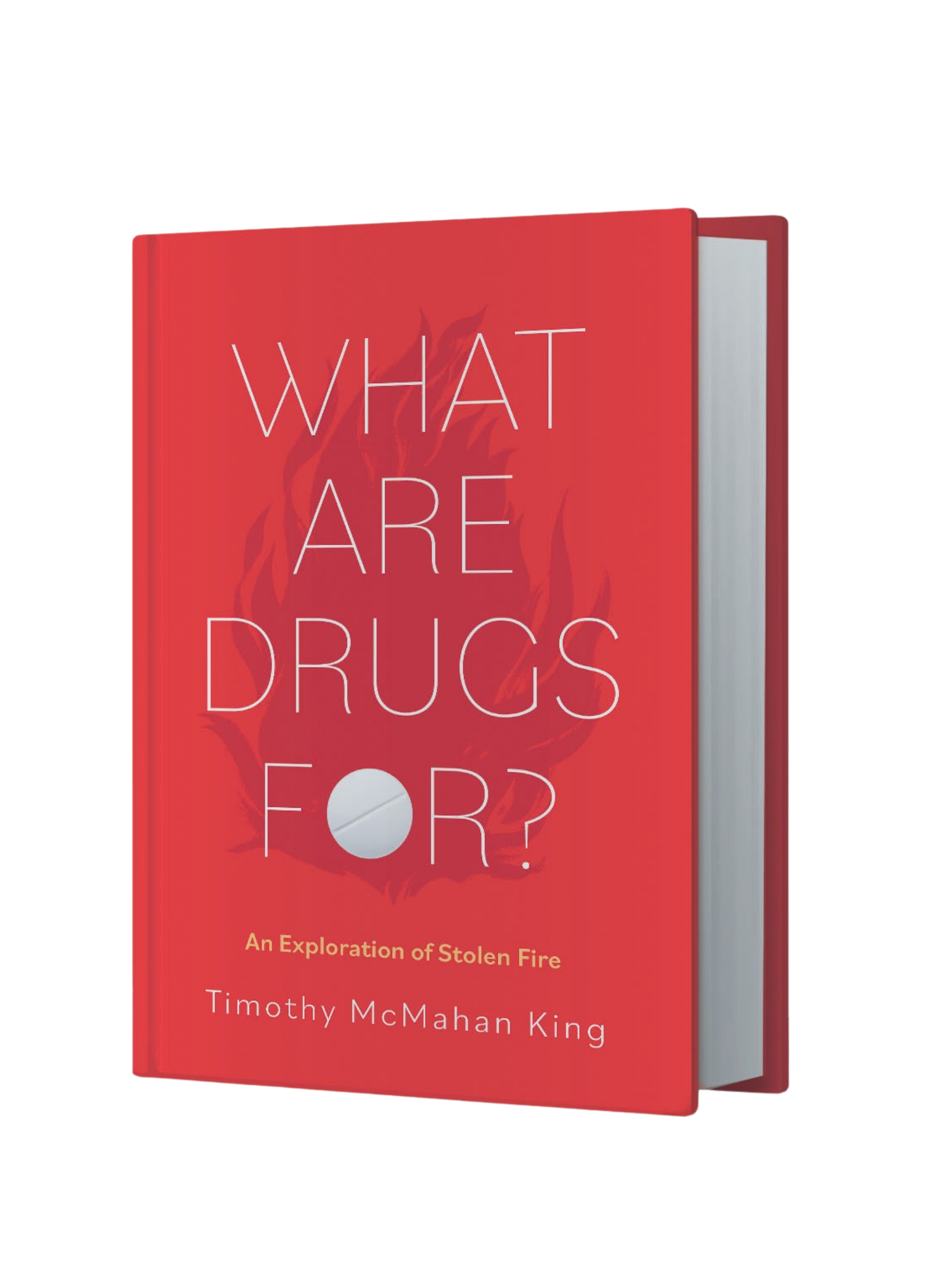
Drugs are tools for human flourishing, best known for their powers of destruction. This book is about what makes the difference.
“One of the most important books ever written about mind-altering substances.”
Now available for pre-order.




Drugs have always been the fire that can warm or burn.
Prometheus stole fire from the gods and gave it to humanity. It was the foundation of civilization and the cause of immeasurable destruction. Is fire a blessing or a curse? The answer depends on us.
Drugs are a part of our history for better and worse. But even a complete catalog of all of their harms and potential uses does not answer the question this book raises: what are drugs for?

This book draws on history, theology, anthropology, neuroscience, and philosophy and traces humanity's relationship with mind-altering substances across thousands of years — from ancient temples to modern clinical trials. These are not simple answers to our contemporary challenges but a new way of thinking that can help us reimagine a path forward. Fire is not good or bad but an ancient gift that requires our wisdom to use well.
Who This Book Is For
For anyone who has ever suspected that the conversation about drugs is too simple.
The Curious Reader
You have watched the headlines shift from the war on drugs to the psychedelic renaissance and wondered how we got here and where we are headed. This book offers the long view.
The Caregiver
You work with people whose lives have been shaped by drugs in good ways and bad. Standard narratives don’t make room for all your lived experiences, and you are looking for a larger story.
The Person of Faith
You sense that the old ways of talking about drugs leave something important out, and you are open to a deeper, more historically honest engagement with questions of body, mind, and spirit.
The Recovering Person
You know firsthand that the standard narratives about addiction, recovery, and why people use drugs are incomplete. This book takes your experience seriously and situates it within a much larger human story.
The Policy Thinker
You know prohibition and the drug war have failed, but you aren’t sure what comes next. You are looking for a more durable framework rooted in history and honest about complexity
The Skeptic
You came in expecting a polemic — for or against. You will not find one. What you will find is a writer who changed his own mind in the course of his research, and invites you to do the same.
Inside the Book
Twelve chapters across the full arc of human (and prehuman) history.
-
The myth of Prometheus is where we root our exploration. Like fire, drugs arrived as gifts with the power to warm and destroy, and the wisdom to use them well has always been hard won. Our moral discourse is broken and needs a new common story.
-
Before human history began, there were drugs. To understand our current relationship, how we got to the place we are today, we need to understand where drugs came from and how they helped, harmed, and shaped our ancestors.
-
From the soma hymns of the Rig Veda to Neanderthal flower burials, before our ancestors understood drugs scientifically, they engaged them spiritually. For every benefit a drug brought to early human communities came a new danger.
-
Drugs in society today have long been understood as agents of destruction for our brains and the enemies of wisdom. But early philosophers saw a role for pharmacological catalysts for inspiration and transcendence. What guidance might figures like Socrates and Plato have for those on that path?
-
This chapter explores a pharmacological dimension of ancient Hebrew religious practice and what it reveals about the relationship between altered states and the presence of the divine. The rise and fall of the first king of Israel has important lessons for our current moment if we are ready to heed them.
-
Early Christian baptism and anointing rites were initiation into a community of the anointed. This chapter explores a forgotten story of how the world’s largest religion first got its name and how the once-central practice of anointing faded in significance.
-
Coffee, sugar, tobacco, and alcohol did not just accompany the rise of modernity — they helped produce it. This chapter traces how the trade in mind-altering substances fueled empire, capitalism, and the disenchantment of the Western world.
-
The temperance movement was not simply naive moralism. It was also a movement of the marginalized to fight back against rich and powerful oppressors. This chapter recovers the complexity of the road to Prohibition as a story bound up with slavery, racism, revivalism, and genuine moral conviction.
-
When alcohol's legal status was restored, the pharmacological theology developed during Prohibition did not disappear. It simply made its home in a new set of demonized substances. The war on drugs was rooted in a moral logic that was soon forgotten and soon took on a life of its own.
-
This chapter examines what happens when a society's relationship to drugs is governed by a will to power rather than reverence, co-opting some plants of the gods for its own ends while seeking total control over others. The rise and fall of this vicious experiment offers one of history's clearest illustrations of what it looks like when the fire is wielded without justice.
-
We return over and over to the lessons of Prometheus that we have yet to learn. This chapter explores why a return to reverence and justice is not just key to controlling a pharmacological fire, but all the many forms of pharmakon.
-
The answers will be found in neither blanket prohibition nor uncritical permissiveness. The final chapter searches for a framework that can hold the full complexity of drugs' place in human life through drawing on ancient wisdom without pretending we can simply return to the past.
-
A personal note on the painful journey of drugs that have both harmed and helped in the authors own life and gives a word of hope to fellow pilgrims on the way.
What You Will Gain From This Exploration
A new way of thinking, not an easy set of conclusions.
— A genuinely historical perspective on drug use from early evolution to thousands of years of human history that allows you to see the present moment anew.
— A framework for thinking about drugs that goes beyond the usual debate between prohibition and permissiveness, grounded in the concepts of reverence and justice.
— A new understanding of how contemporary drug policy was shaped and how much of its moral logic has religious roots that have gone largely unexamined.
— An honest engagement with the drugs, spirituality, and religion–from psychedelics to opium.
— A sense of why the question "what are drugs for?" matters not just for drug policy, but for how we think about meaning, community, technology, and what it means to flourish.
— A new moral narrative for understanding drug use that creates more compassionate and accurate picture of addiction, one that neither reduces it to moral failure nor ignores the real harm it causes.
Stay in the conversation
I write on faith, drugs, and drug policy at Clergy for a New Drug Policy on Substack.
A foundational text. In a single volume, a coherent narrative about how we have arrived at the current moment in the conversation (or lack of), about “drugs.”
— Rev. Dr. Jaime Clark-Soles, Professor of New Testament, Perkins School of Theology, SMU
A fascinating story hidden in plain sight within the narratives we think we know in a way that doesn’t simply challenge our assumptions about drugs but opens entirely new terrain for thinking about both the promises and perils of consciousness-altering substances.
— Dr. Natalie Wigg-Stevenson, Associate Professor of Contextual Education and Theology, Emmanuel College of Victoria University
A necessary theological disruption, naming how fear, racialized moralism, and carceral imagination have shaped our stories about drugs more than love, truth, or care.
— Dr. Melva L. Sampson, author, The Pink Robe Chronicles: Womanist Wisdom for Healing, Liberation and Love
A work of rare intellectual courage and bold theological imagination.
— Corey D. B. Walker, Dean, Wake Forest School of Divinity
About the Author
A cut-rate prodigal inspiring others to embrace the messy intersection of faith, science, drugs, and addiction.
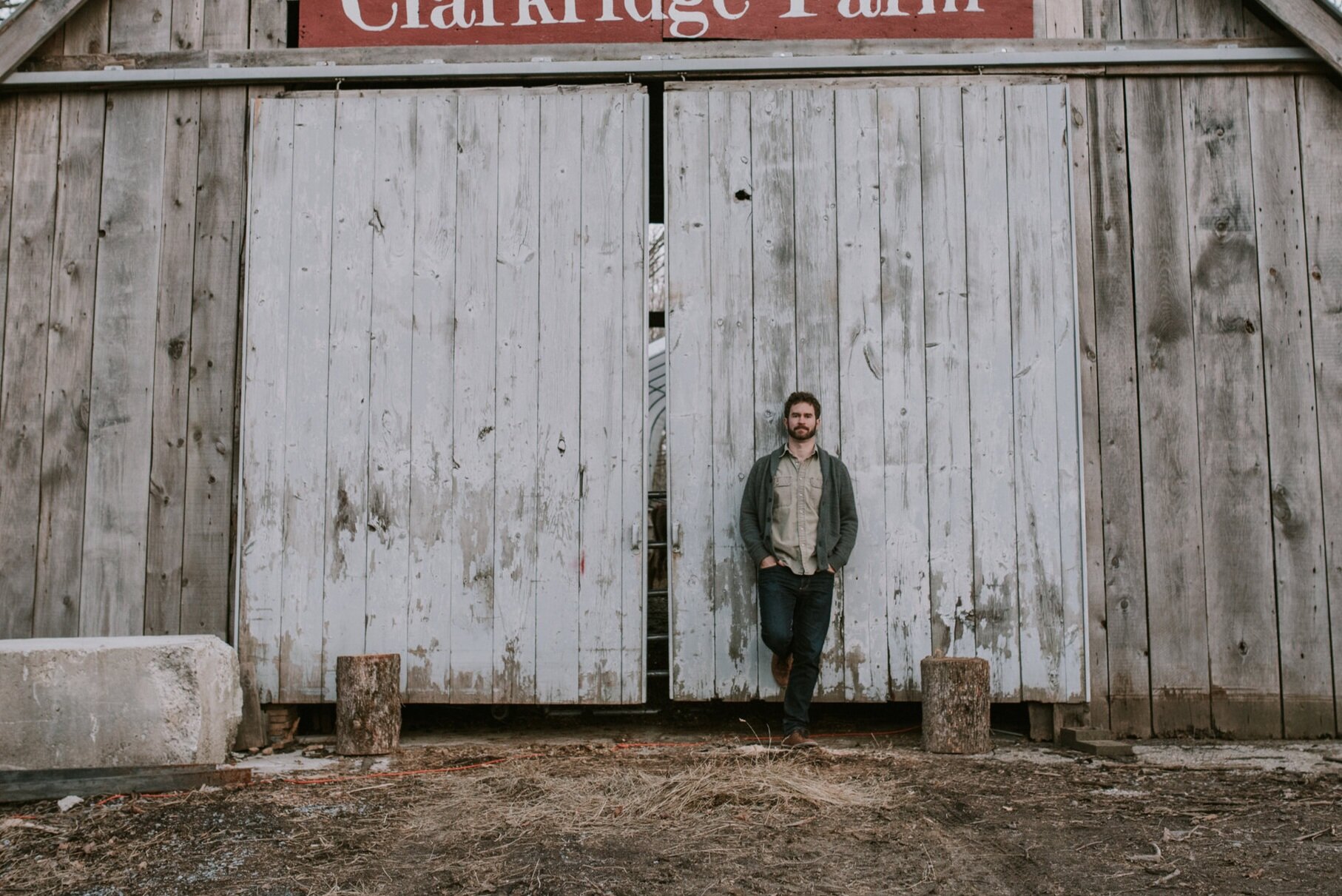
Rev. Timothy McMahan King is a deacon in the Episcopal church and a writer whose work sits at the intersection of faith, public health, and justice. His first book, Addiction Nation: What the Opioid Crisis Reveals About Us (Herald Press, 2019), told the story of the overdose crisis not as a tale of individual moral failure but as a collective reckoning.
What Are Drugs For? grew out of that work. It begins with a recognition that to understand the crisis requires going much further upstream, into the deep history of humanity's relationship with mind-altering substances. The research changed him. What began as a polemic became something more honest and more difficult: an exploration.
He writes, speaks, and consults on issues of addiction, faith, and drug policy.